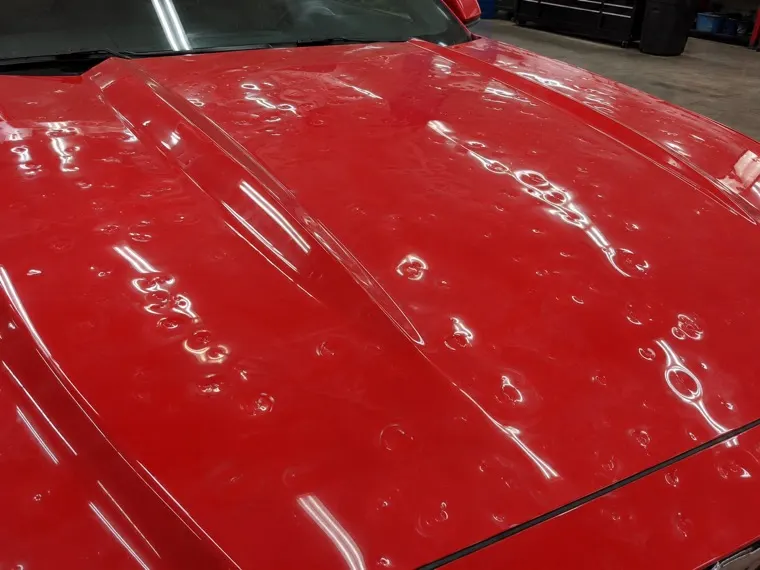
One or Two Panels
$500 to $1,500
Same day to one day
A hood, or a hood and roof, caught the edge of a storm. Light dimple count, every one worked from behind the panel.
Every dimple. No repaint. Hail lands on the hood and roof, the two panels a buyer checks first. Each impact is worked from behind the panel so the factory finish stays, with nothing on the vehicle history. $500 to $8,000 depending on the storm, and the one repair where an insurance claim usually earns its place.
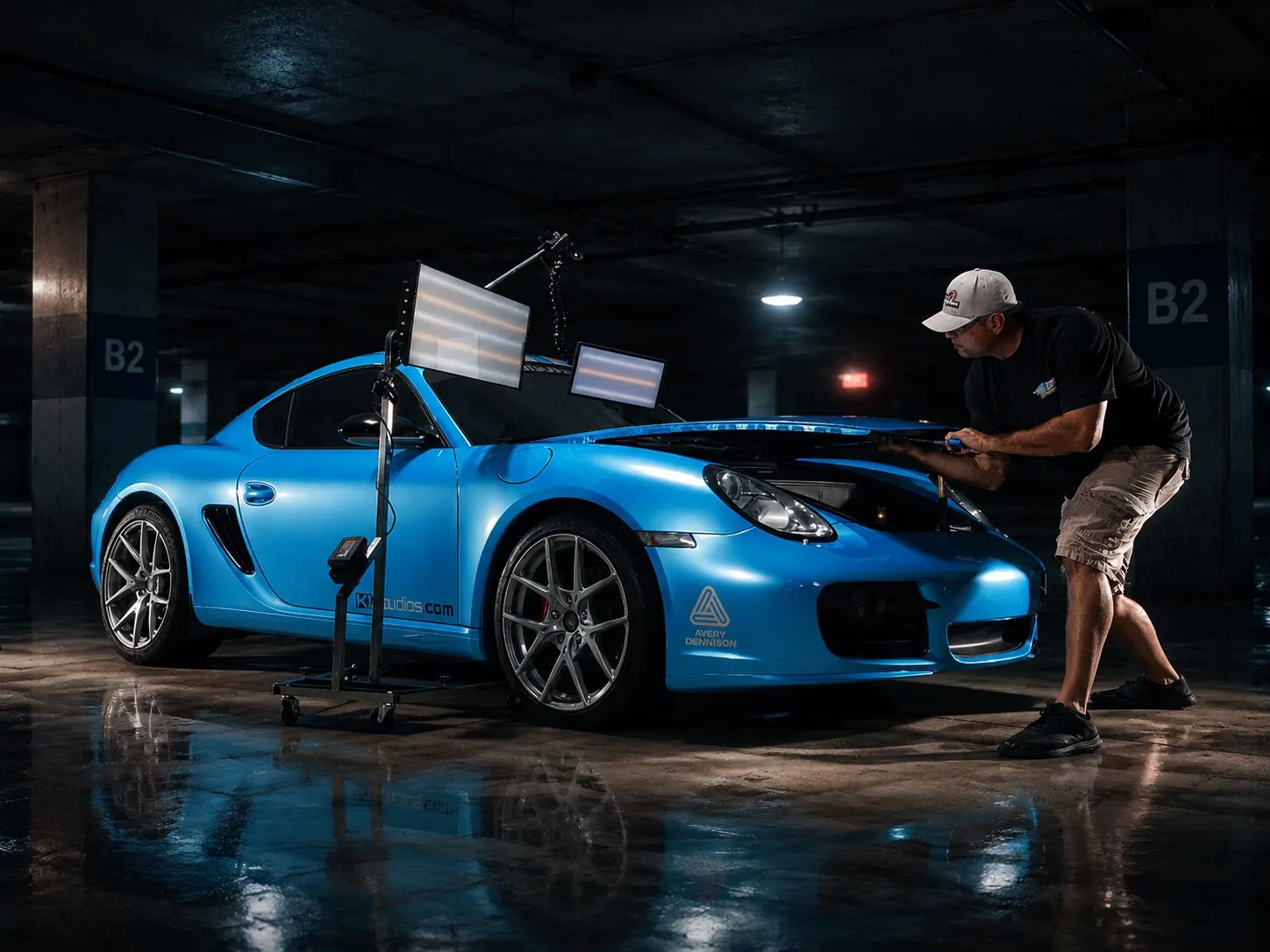
There is no trick to hail. It is one impact at a time, from behind the panel, checked against a reflection board. Tap WATCH and the whole page becomes the theater, sound on.
Drag or use the arrows · tap watch for full screen
Because San Diego does not get the hail. The cars do, somewhere else, and then they arrive here. Most hail repair in San Diego County is out-of-state hail: a relocation from Texas or Colorado, a car bought online from the Midwest, dealer inventory trucked in, or a road trip through storm season. San Diego County does get an occasional inland hail event, but it is the least common source, not the main one.
This matters for one practical reason. Hail is a comprehensive insurance claim no matter where or when the storm happened. Owners assume that damage from another state, or from two years ago, is somehow no longer claimable, so they never ask. Then they trade the car in and eat the discount instead.
You do not need a police report, a storm date, or a weather record. You need photos of the panels and a real number, which is a five-minute conversation.
A relocation from Texas, Colorado, Oklahoma, Nebraska, or the Midwest. The storm happened months ago and a thousand miles away. The dimples came with it.
Online purchases and auction cars ship in from hail country every week. The listing photos never show a dimpled roof, because a roof photographs flat.
Dealers move inventory nationally. A car can be trucked in with hail already on it and sold with a discount that never mentions why.
Drive to Denver, Dallas, or Phoenix in storm season and you can come home with a hood full of impacts from twenty minutes of weather.
It does happen. San Diego County gets an occasional hail event, usually inland and in the mountains. It is the least common source, not the main one.
Hail does not make one dent. It makes a count, and the count is the job.
Hail hits horizontal surfaces hardest, so the hood, roof, and trunk take the worst of it, and vertical panels like doors and quarters only get hit in heavier or wind-driven storms. Count the impacts on the hood and the roof and you already know roughly where your repair lands. One warning: straight-on photos hide hail almost completely. Shoot at an angle so the light rakes across the panel.
Two angled photos of the hood and roof, and you get a real range plus a straight answer on whether a claim is worth filing. No claim gets opened on our end. That call stays yours.
The most common question San Diego drivers ask after a bad experience is: how was I supposed to know? The answer is always visible, if you know what to look for. Poor PDR leaves metal that was pushed with the wrong tools, clearcoat stressed or cracked from sharp contact, and in some cases holes drilled where none belonged. None of that can be undone by another technician. Every car in this section was dent-repairable before the first shop touched it. This is what to look for before you hand your car to anyone.
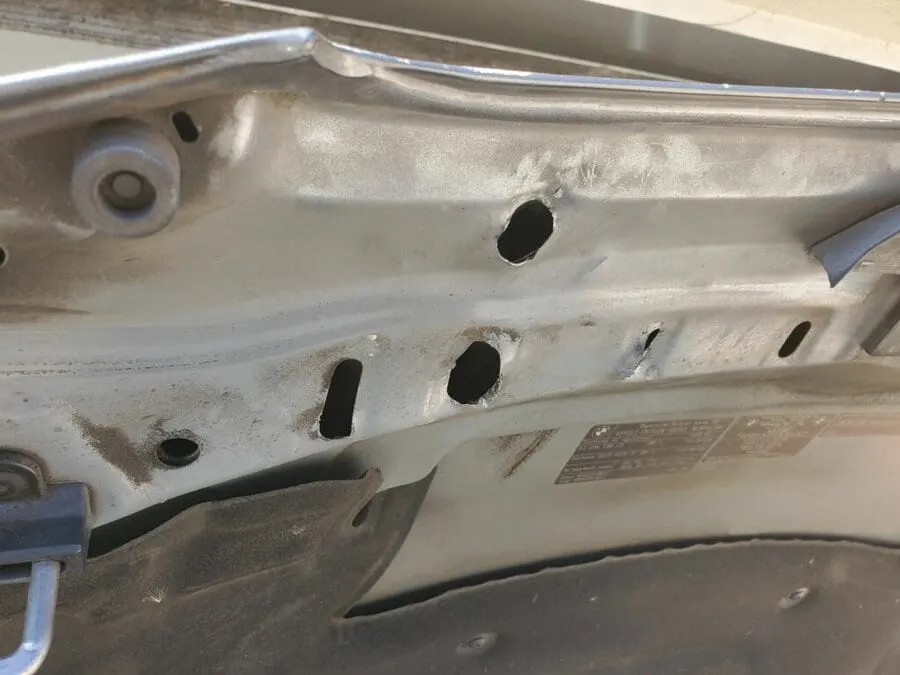
Multiple holes drilled through the panel where none were needed, then left open, unsealed, unprotected. Every one of those openings is now a rust point working inward. The structure is compromised.
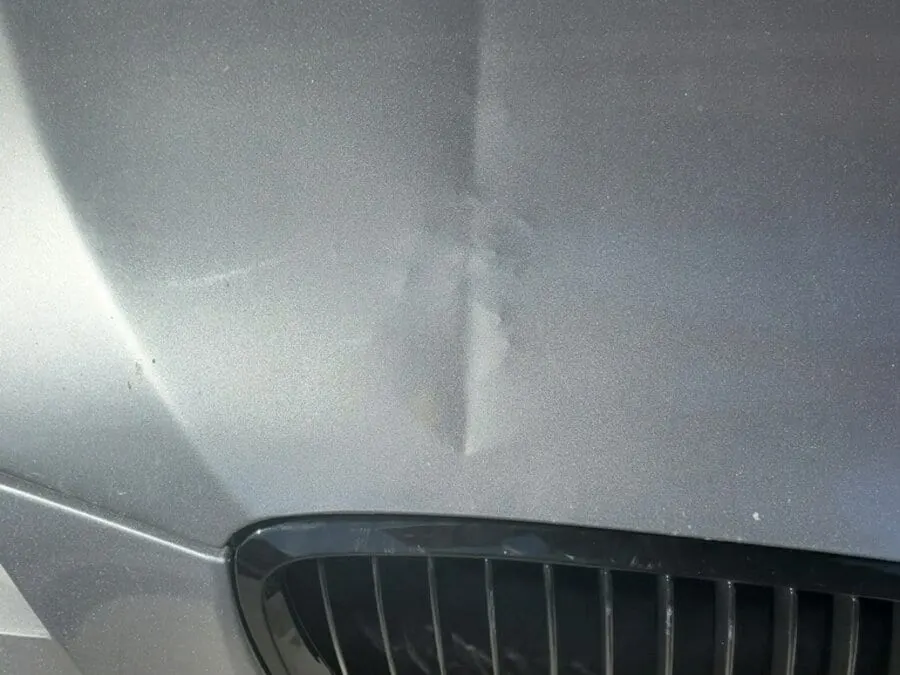
Done by a technician who called himself experienced. A sharp tool pushed with too much force created high spots across the hood and stressed the paint at every contact point. Once the paint is broken from underneath, PDR is no longer an option. The panel needs a full respray.
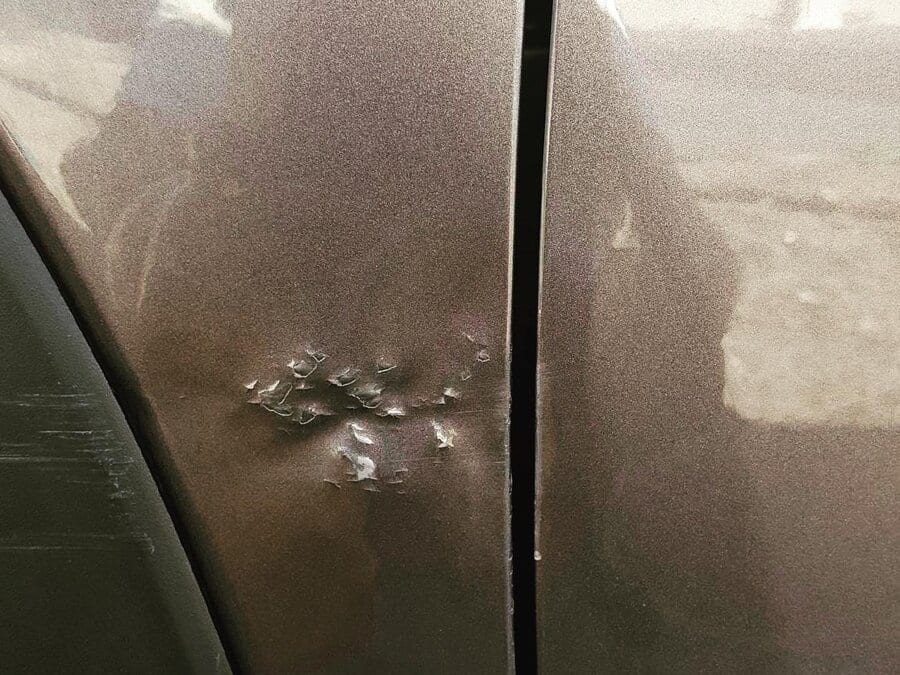
Aggressive pushing with the wrong tools poked the metal up from underneath across the panel. Each raised point broke the paint surface from below. There is no pushing these back down. The factory finish is gone.
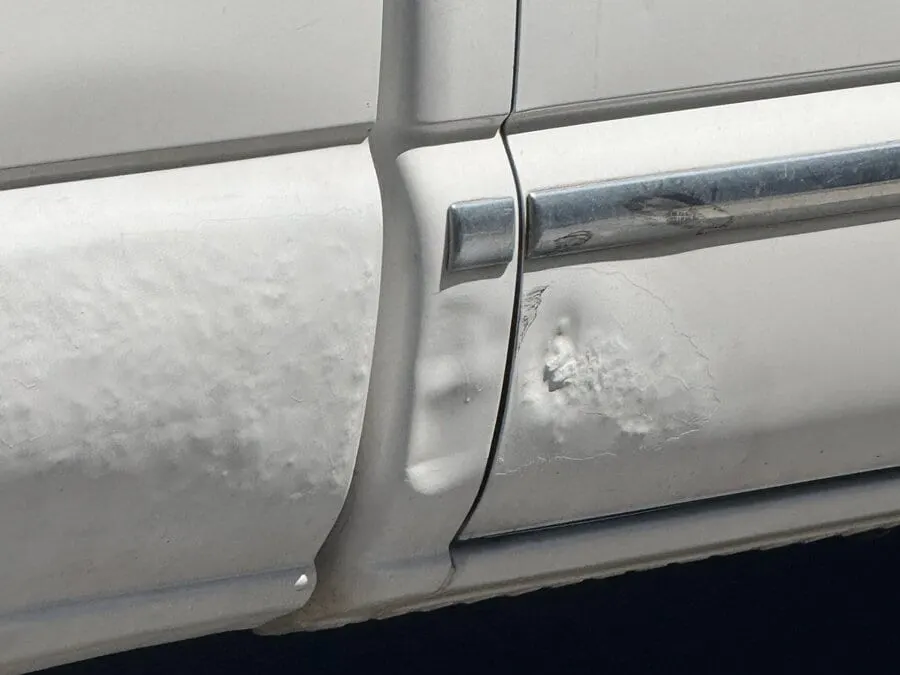
A mobile company in a Walmart parking lot told the owner it would wash away by tomorrow. It didn't. What they applied bonded to the paint and lifted it, leaving the panel in worse shape than the original dent. This car now needs new panels and collision work that could have been avoided entirely.
Every panel above was dent-repairable before the first technician touched it. The damage in these photos was not caused by the original impact, it was caused by the repair. That distinction matters, because it changes what you are actually deciding. The dent is not the risk. The technician is.
Myke Toledo · Dent Time
When you buy a gallon of milk, every gallon at every store is the same product. Choosing the one that costs less makes sense. PDR is not that. Two technicians looking at the same dent will make completely different decisions about access, pressure, and where to stop. One of those decisions preserves your factory finish. The other one does not.
Thirty-five years in this trade is not a marketing number. It is the count of dents, panels, and metal types that live in a technician's hands as muscle memory. You cannot buy that experience at a lower price point. You can only find it or not find it.
The tool does not read the metal. The technician does.
Hail repair runs $500 to $8,000 or more, priced by the storm rather than by the dent. One or two lightly hit panels run $500 to $1,500. A light to moderate storm across the hood, roof, and trunk runs $1,500 to $3,500. A heavy storm with hundreds of impacts across every horizontal panel runs $3,500 to $8,000 or more. Hail is the only repair we quote by count, because the count is the labor.
A hood, or a hood and roof, caught the edge of a storm. Light dimple count, every one worked from behind the panel.
Hood, roof, and trunk with dozens of dimples each. The count is the work, and the count is what the insurer pays on.
Hundreds of impacts across every horizontal panel, sometimes the quarters and doors too. Mapped panel by panel for the claim.
The count sets the price, not the size of any one dimple. A hood with 40 light impacts and a hood with 300 are different jobs at the same width. Panel access matters too, since a roof is reached through the headliner area and a trunk often has bracing right behind the hits. Send angled photos of the hood and roof through the estimate form for your real range in minutes.
Usually yes, under comprehensive coverage. Hail is not an at-fault event, so a hail claim generally affects your premium less than a collision claim does. On most other dents we will tell you to skip the claim and pay out of pocket. Hail is the exception, because the repair total is often several times the deductible, and that math is hard to argue with.
What we do for the claim: every panel gets mapped under a reflection board and every impact counted, which is the documentation a carrier pays a supplement on. Then we deal with the adjuster directly. You are not required to use a shop your insurer recommends, in California or anywhere else. That choice is yours.
The honest version of the trade-off, including when a claim is the wrong move, is on our insurance claims page. Read it before you call anyone.
After a storm, catastrophe crews follow the weather. They set up in a hotel lot or a strip mall, work volume as fast as they can, collect the insurance money, and move to the next region. Some of those technicians are genuinely good. The problem is not always the skill. The problem is that a hail repair is judged months later, in garage lighting, and by then there is nobody local to answer for it.
Hail is the easiest repair in this trade to leave 90 percent finished. A hood with 200 impacts, worked fast, can look flat in a parking lot and show every one of them the first time it sits under a light board or beside a painted parking line. That is the exact repair that gets found at trade-in, when it is no longer anybody's problem but yours.
Hail before-and-after pairs from our own storm cars are being added here. Until they are, the fastest honest answer is your own panels. Send angled photos of the hood and roof and you get a real range plus a straight opinion on the claim, usually within minutes.
Get a Call BackOn almost any car worth keeping or selling, yes. Hail sits on the hood and roof, which are the first two panels an appraiser or a private buyer looks at, and hail is visible from across a lot in the right light. Dealers discount a hail car aggressively, usually by well more than the repair costs, because they have to move it as a hail car.
Paintless repair is what makes that math work. There is no repaint, so there is no panel that photographs slightly off from the one next to it, no paint work in the service history, and nothing reported to Carfax. The car appraises as what it is instead of as a storm car.
The alternative is worth stating plainly. A body shop fixing hail means sanding, filling, and repainting the largest, flattest, most visible panels on the vehicle. That is a repaint on a hood and roof, and it follows the car for as long as the car exists.
Dent Time repairs hail damage at our Escondido shop, serving all of San Diego County. Heavy hail work belongs in a shop with controlled lighting, because every impact has to be checked under a reflection board.
There is no honest calculator for hail, because the number comes from the panel count and the dimple count. Two photos of the hood and roof get you a real range in minutes instead of a guess.
Paintless dent repair is the standard hail repair. Every dimple is pushed back from behind the panel with the factory paint untouched, which is what keeps a hail car from looking like a repainted one.
On almost any car worth keeping or selling, yes. Hail sits on the panels buyers check first, and dealers discount a hail car by more than the repair costs.
Hail is a comprehensive claim, which usually affects your premium less than an at-fault collision. We document every panel for the carrier and handle the supplement.
Hail repair runs $500 to $8,000 or more, priced by the storm rather than by the dent. One or two lightly hit panels run $500 to $1,500. A light to moderate storm across the hood, roof, and trunk runs $1,500 to $3,500. A heavy storm with hundreds of impacts across every horizontal panel runs $3,500 to $8,000 or more. The panel count and the dimple count per panel set the number, which is why hail is quoted from photos of the actual car.
Yes, and it is the preferred repair for hail. As long as the paint is intact, every dimple is worked from behind the panel and the factory finish stays. That matters more on hail than on any other damage, because a hail car has damage on the panels a buyer inspects first. A repainted roof and hood on a resale listing costs far more than the repair did.
Usually yes, under comprehensive coverage. Hail is not an at-fault event, so a hail claim generally affects your premium less than a collision claim. This is the one repair where filing usually earns its place, because the repair total is often several times the deductible. We map every panel and every dimple for the claim and work with your carrier directly.
Comprehensive. Hail sits in the same category as vandalism and falling objects, which is the coverage that usually has the smaller effect on your rate. A dent from hitting something, or being hit, is collision. Knowing which one you are filing before you call the carrier is worth a five-minute conversation.
Yes, and this is most of the hail work in San Diego. The county stays dry, but the cars do not. We regularly repair vehicles that caught a storm in Texas, Colorado, Oklahoma, or the Midwest before they arrived on the coast, whether the owner relocated, bought the car out of state, or drove through it. Hail is still a comprehensive claim, and mapping every impact for the supplement is exactly what we do.
One to four days at the shop, depending on the panel count. A couple of lightly hit panels can finish in a day. A heavy storm car across every horizontal panel takes two to four days, because there is no way to shortcut hundreds of individual impacts. Anyone promising a heavy hail car back in an afternoon is telling you what the work will look like.
Almost always yes. Hail lands on the hood and roof, which are the first two panels a buyer or an appraiser looks at, and hail is visible from across a lot. Dealers discount a hail car aggressively, usually well past the cost of repair. Paintless repair fixes it with no repaint and nothing on the vehicle history, so the car appraises as what it is.
Sometimes, on older or lower-value vehicles where the repair total approaches the vehicle value. On most cars it is not close. If your car is heading toward a total loss, you should hear that from the person estimating it, not find out later. We tell you where you actually stand before you file.
Hail is the one repair where the honest answer is days rather than hours, because there is no way to shortcut hundreds of individual impacts and anybody promising otherwise is planning to leave some in. What it is not is a body shop repaint, which means your factory paint stays, nothing lands on the Carfax, and the car does not lose resale value on the way through. That is the trade worth measuring, not the clock.
That is your call, but understand what you are choosing. Catastrophe crews follow storms, work out of temporary locations, take the insurance money, and leave the region. If something needs to be corrected afterward, there is nobody local to correct it. We have been at the same Escondido shop since 2001 and repairing dents since 1991. If a repair of ours needs another look, we are still here.
Yes. Aluminum hoods and roofs are common now, on Fords, Toyotas, BMWs, Mercedes, and EVs alike, and aluminum has no memory. It gives nothing back, so every impact takes more force and more accuracy than the same dimple in steel. On a hail panel that difficulty multiplies by the dimple count, which is why aluminum hail runs higher and why the technician matters more.
When a claim earns its place and when it costs you more than the repair.
The single big impacts most mobile operators quote a replacement panel for.
Aluminum hoods and roofs, the metal with no memory, on far more than EVs.
The full price ladder and the five factors that actually move a number.
Shoot the hood and the roof at an angle so the light rakes across the panel. A technician replies with the range, the panel count, and a straight answer on whether the claim is worth filing. Photos welcome any time, day or night.
Leave your name and number and Myke will call you back during business hours, Monday to Friday, 8:30am to 4pm.
Julie texts you back right away from (858) 408-6200.