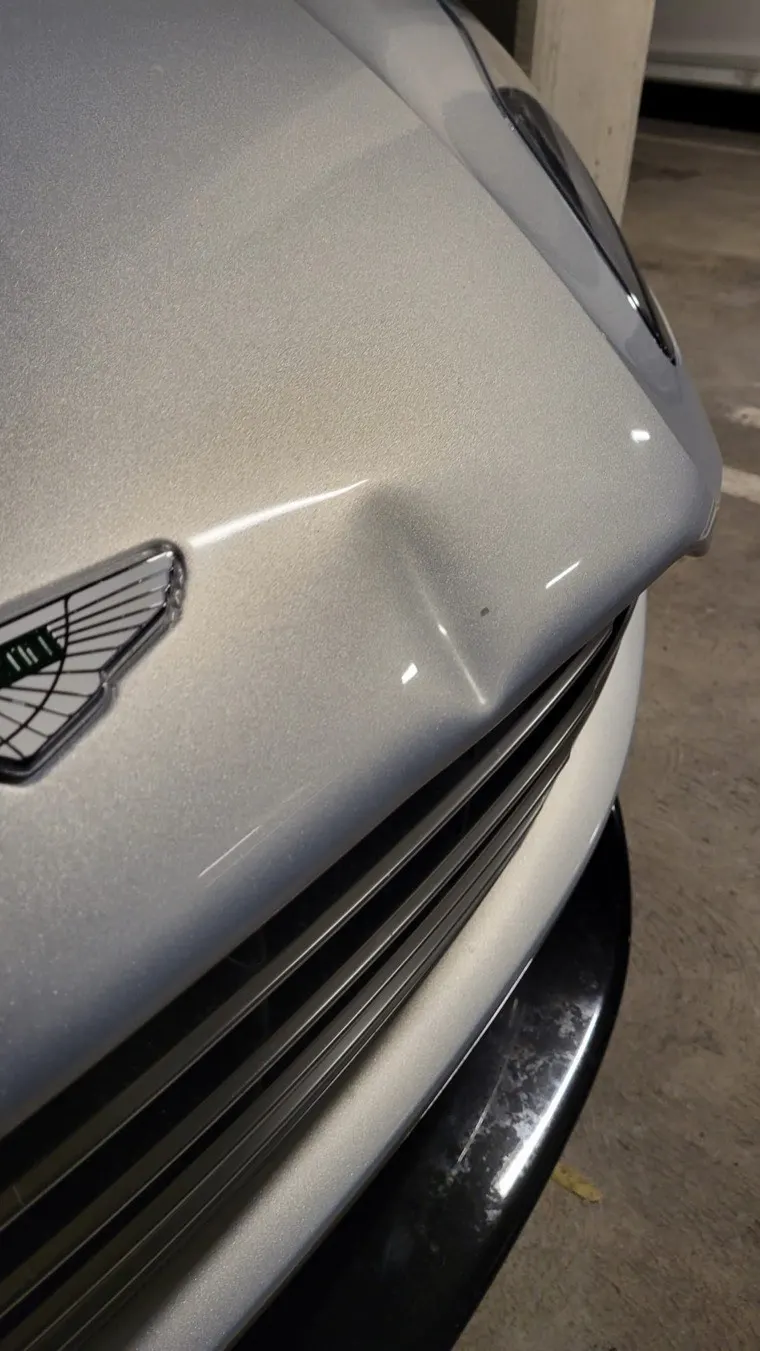
Open-Panel Crease
$225 to $450
2 to 3 hours
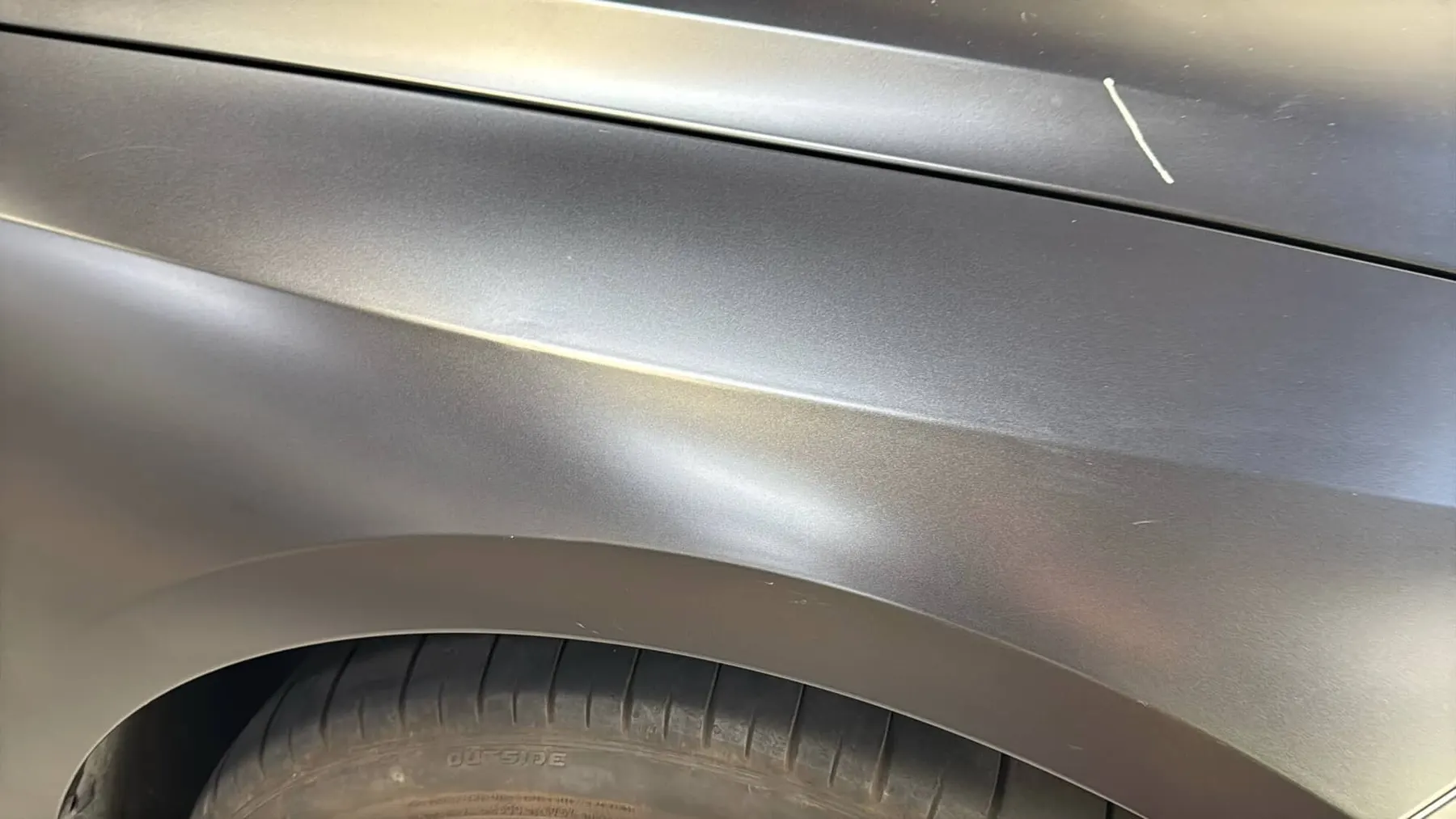
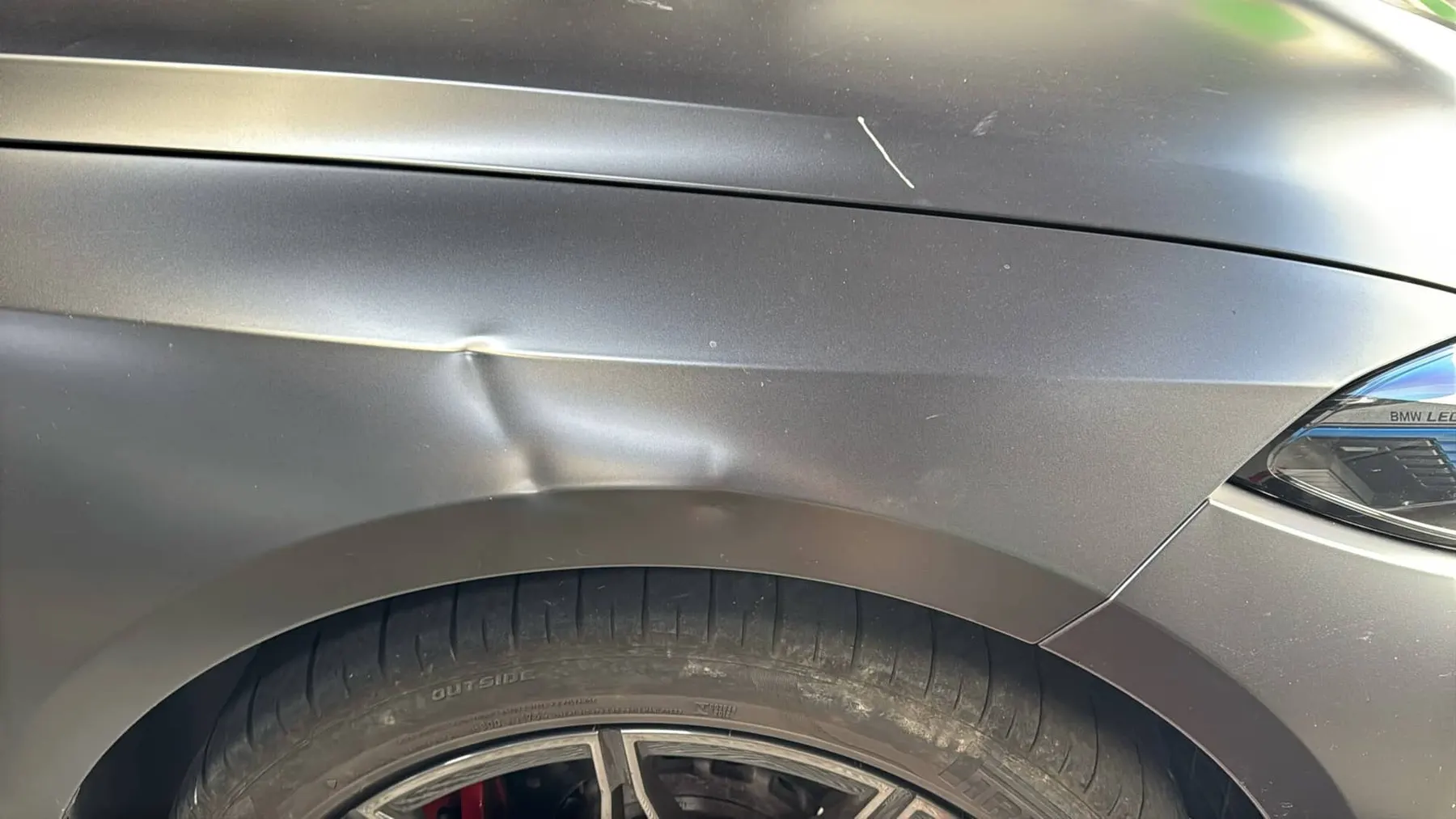
A crease in the flat middle of a panel, away from any line. The metal moves freely on both sides, which makes this the most forgiving version.
A crease is not a big dent. It is a different repair. The metal is bent along a line instead of pushed in at a point, so it comes back in stages and the body line has to run dead straight when it is finished. $225 to $600 for most creases, with no filler, no repaint, and nothing on the vehicle history.
A crease returns in stages, read against a board the whole way. Tap WATCH and the page becomes the theater, sound on.
Drag or use the arrows · tap watch for full screen
Answer four quick questions for a preliminary range. Send photos and a technician replies in minutes with a written estimate.
What's behind the panel can change this number. Two dents that look identical from outside can be two different repairs, because braces, beams and wiring sit behind some spots and not others. That is why this is a preliminary range, never a quote sight unseen.
See what's behind the panelThis is a preliminary range based on your answers. Send two photos and a technician replies within minutes with a written estimate. The final price is always confirmed in person, once we can see what is behind the panel. No obligation.
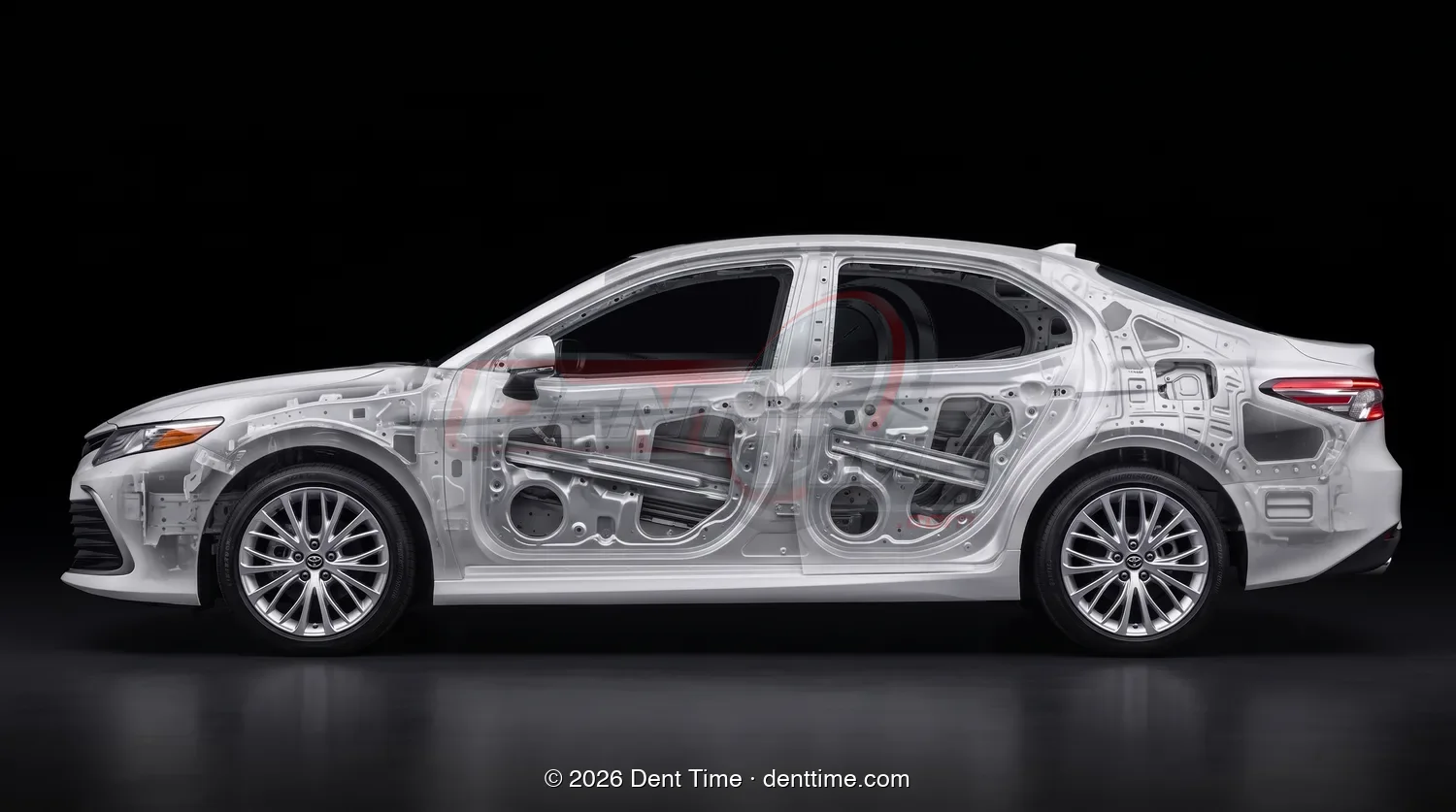
Two dents that look identical from outside can be two different repairs, because braces, beams and wiring sit behind some spots and not others. That is why this is a preliminary range, never a quote sight unseen.
A dent is an impact at a point. A crease is a fold along a line. Picture folding a piece of paper and then trying to iron the crease out of it: flattening the paper is easy, making the fold disappear is another thing entirely. That is the difference between a dent and a crease, and it is why they are priced differently.
It is also why a crease costs more than a dent that measures the same across. The bend is concentrated, which stretches the paint more than a broad impact does, and creases tend to land on the parts of a panel that fight back hardest. None of that is visible in a description over the phone, which is why the quote comes from photos.
Think of a crease like folding a piece of paper and then trying to iron the line out. You can press it flat. Making the fold disappear is a different job, and it takes far more than pressure. That is exactly what is being asked of the metal in your panel.
Three things set the price, and all three count: how sharp it is, how long it runs, and what sits behind the panel. Miss any one of them and the quote is a guess.
A tight, sharp crease is a hard fold. The metal is stretched along a narrow line and the paint is stretched with it, so every correction risks the finish. A soft, rolled crease is a loose fold in the same paper and comes back far more willingly.
Length is real work, not a detail. Every inch has to be brought back in stages and read against a board, and correcting one section pulls on the next. A crease that crosses a body line or runs onto a second panel adds more again, because the line has to read dead straight when it is finished.
A crease is worked from behind the panel, so access is half the job. An open door skin is the good case. A brace, a liner, a speaker, or a window track in the way means parts come out and go back first. That is real labor and it is why two identical-looking creases can be quoted differently.
A real crease across a tailgate. The metal is folded along its length, and it comes back the same way, in stages.
Sharpness and length you can see from outside the car. The third thing that sets a crease price you cannot see at all, and it is often the one that decides the number. A body line is a stiffening feature, and the panel behind it is usually reinforced along the same run, so a crease that follows a line tends to sit directly over structure.
That changes the job rather than the price alone. Reaching a crease on the open flat of a panel is one thing. Reaching one that lies along an impact beam or a bracket means getting to the back of it first, sometimes through a door card or a liner, and working it in stages down the whole length rather than pushing at a point. Drag the slider and you are looking at the reason two creases that measure the same can be hours apart.
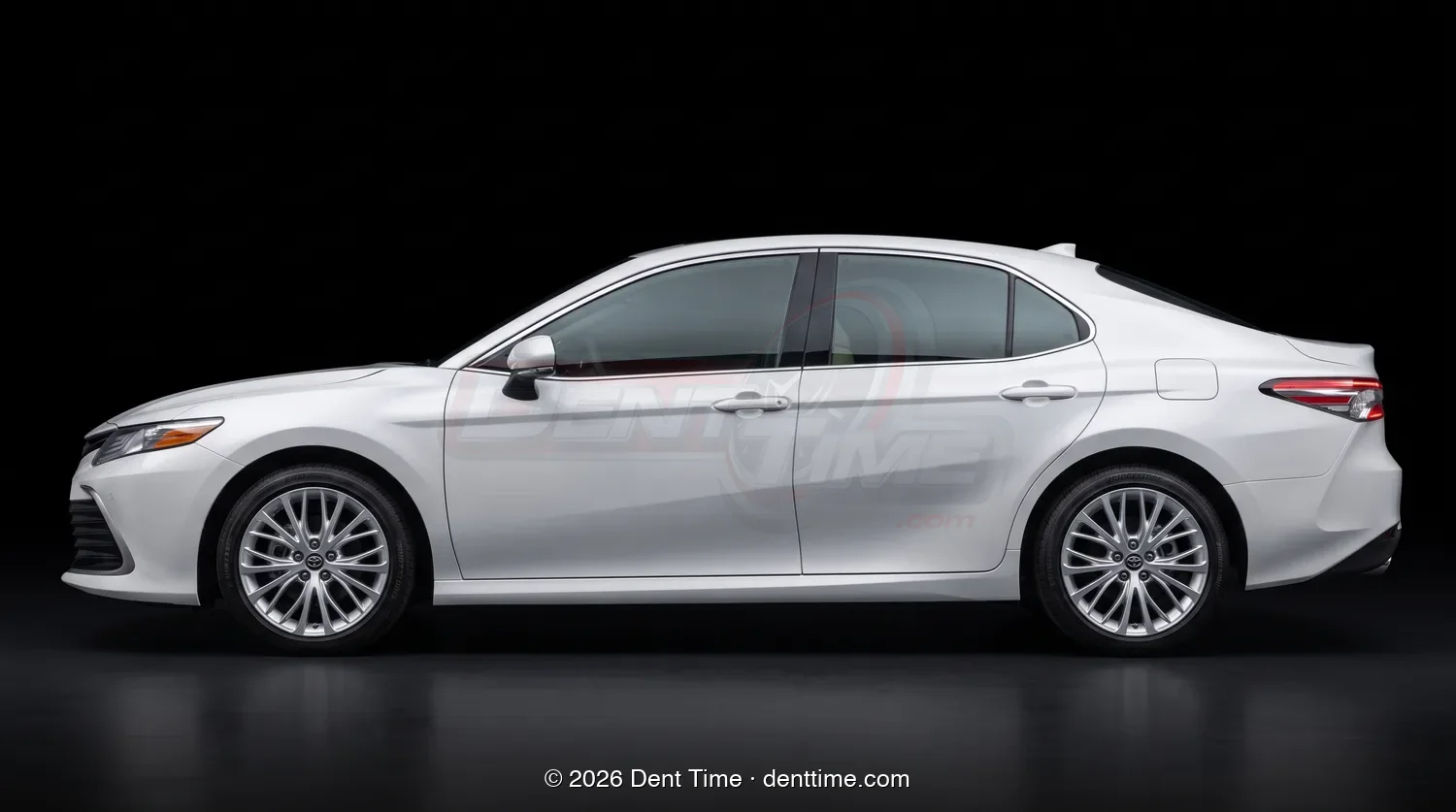
The same car, inside and out. What you can't see is exactly what sets the price.
Your dent may not be on a door, and that changes very little. Hoods, fenders, quarter panels and tailgates all have structure behind them too: braces, reinforcement bars, brackets, wiring, and on a hood the whole underframe. Some spots on your car are wide open from behind and take minutes. Others sit directly over a brace and have to be reached a harder way, or reached after something comes off first. That is the single biggest reason two dents that look the same are not the same price.
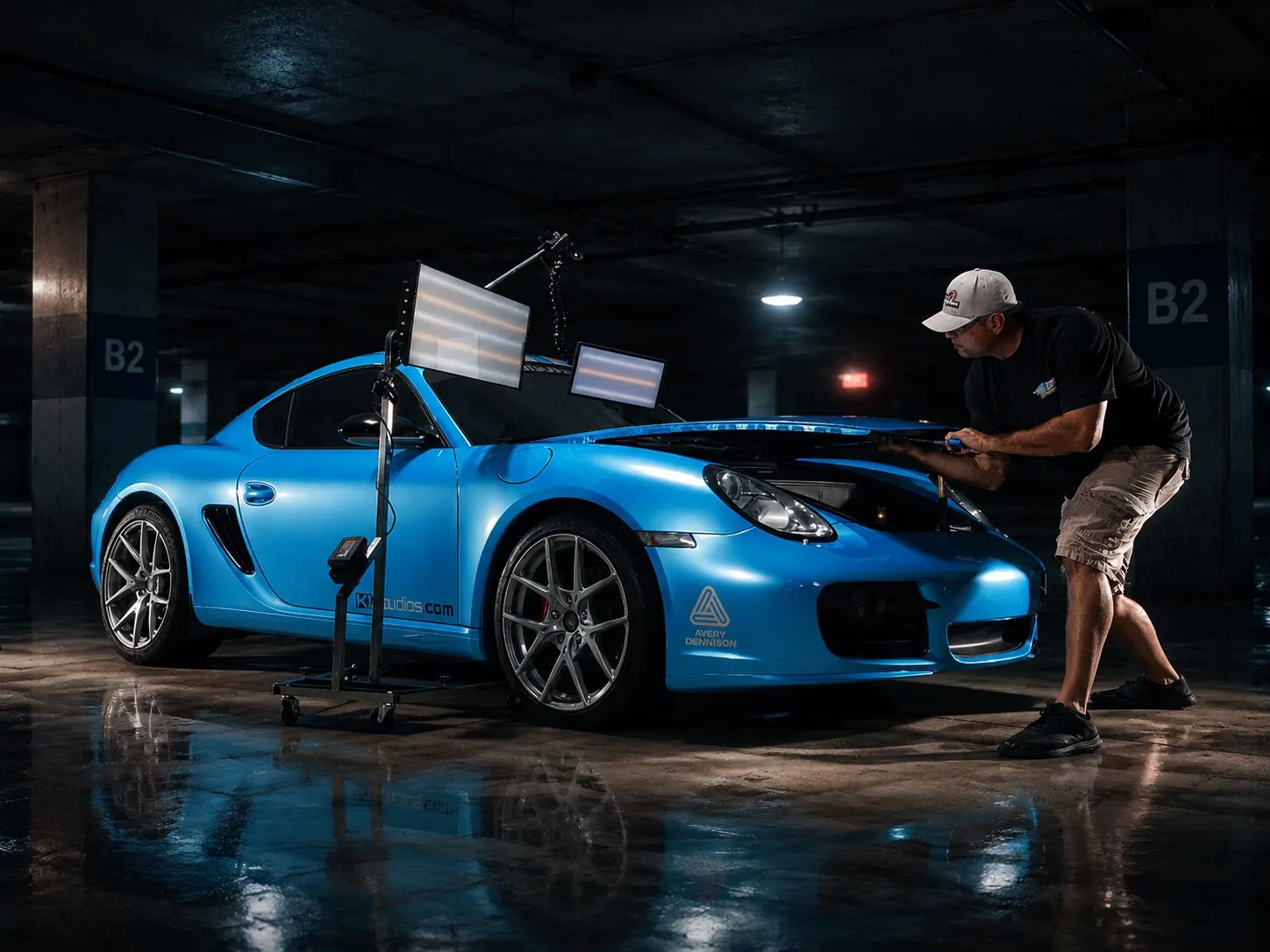
Every crease is worked from behind the panel in stages, and read against a reflection board the whole way. Nothing is filled, nothing is repainted, and the factory finish stays. Most take 2 to 4 hours.
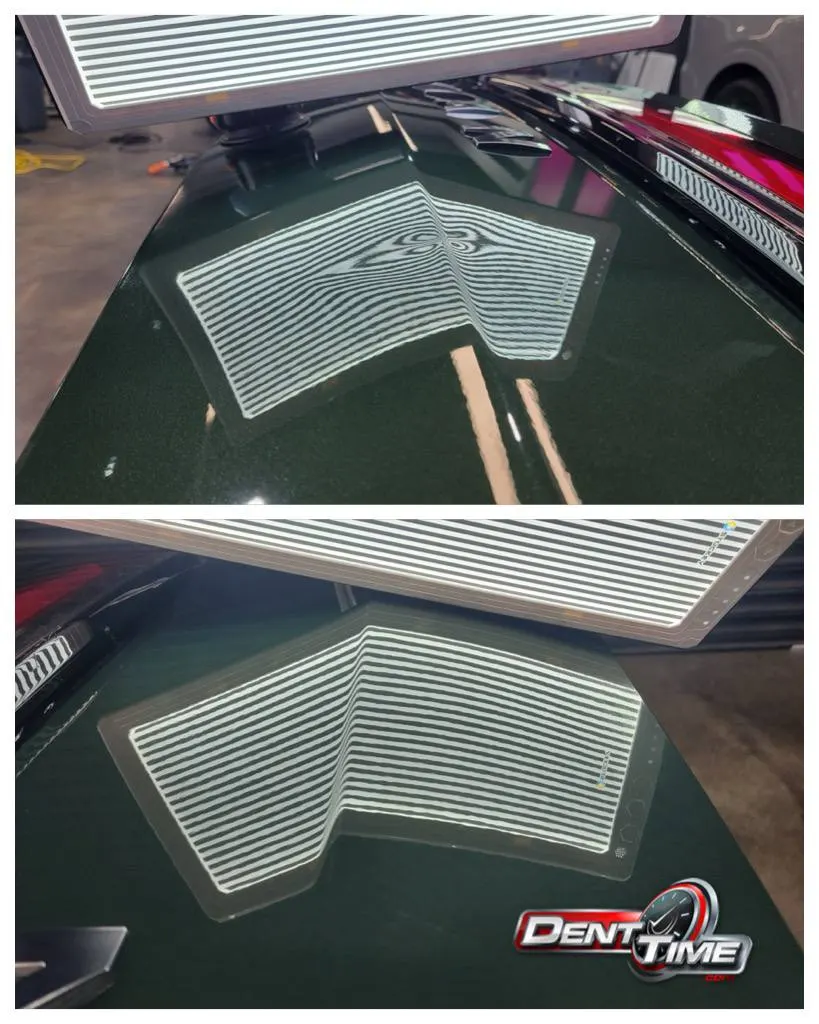
Before anything is touched, the crease is read against a reflection board to find where it is deepest and where the metal is stretched. A crease is never uniform, and starting in the wrong place is what leaves a wave.
Access decides the approach. A door usually means the card comes off. A quarter panel often means going in through the trunk or removing interior trim. That access work is real labor and it is part of an honest quote.
The metal comes back a section at a time, not in one push. Correcting one part of a crease pulls on the next, so the whole length moves together and gets re-read constantly.
On a body-line crease this is the repair. The line has to run true again, because a wave in a body line is visible from across a parking lot in the right light while the same wave in the flat of a door would not be.
The last five percent. Every high spot left along the crease is tapped flat until the reflection runs clean and unbroken. This is the step that gets skipped when someone is being paid by volume.
Want the full technical version, including what a crown is and how one gets left behind? Read how to fix a body line dent.
A crease runs $225 to $600 for most everyday damage. An open-panel crease away from any line runs $225 to $450. A crease on a body line runs $350 to $600. A long, sharp, or stretched crease runs $500 to $1,500 or more. Aluminum panels run higher again, $400 to $900, because aluminum has no memory and a crease already concentrates the work where the metal is least willing to move.
A crease in the flat middle of a panel, away from any line. The metal moves freely on both sides, which makes this the most forgiving version.
A crease sitting on or across a body line. The line has to run dead straight again when it is finished, and that is what sets the price.
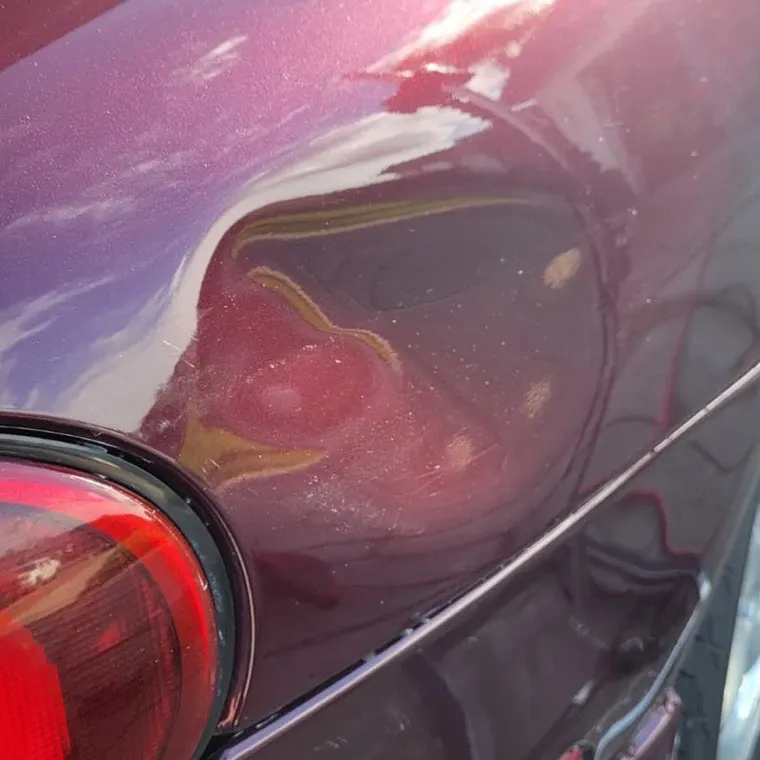
A long crease, a sharp one, or one that stretched the metal. Worked in stages and read against a board the whole way.
Sharpness, length, and access set the price together. A tight fold, a long one, and one you cannot reach behind are three different jobs, and most creases are some mix of all three. Send two photos through the estimate form, straight-on and at 45 degrees, and you get your actual range in minutes. Full ladder on the pricing page.
A crease does not pull the reflection into a point. It shears it into a line.
The most common question San Diego drivers ask after a bad experience is: how was I supposed to know? The answer is always visible, if you know what to look for. Poor PDR leaves metal that was pushed with the wrong tools, clearcoat stressed or cracked from sharp contact, and in some cases holes drilled where none belonged. None of that can be undone by another technician. Every car in this section was dent-repairable before the first shop touched it. This is what to look for before you hand your car to anyone.
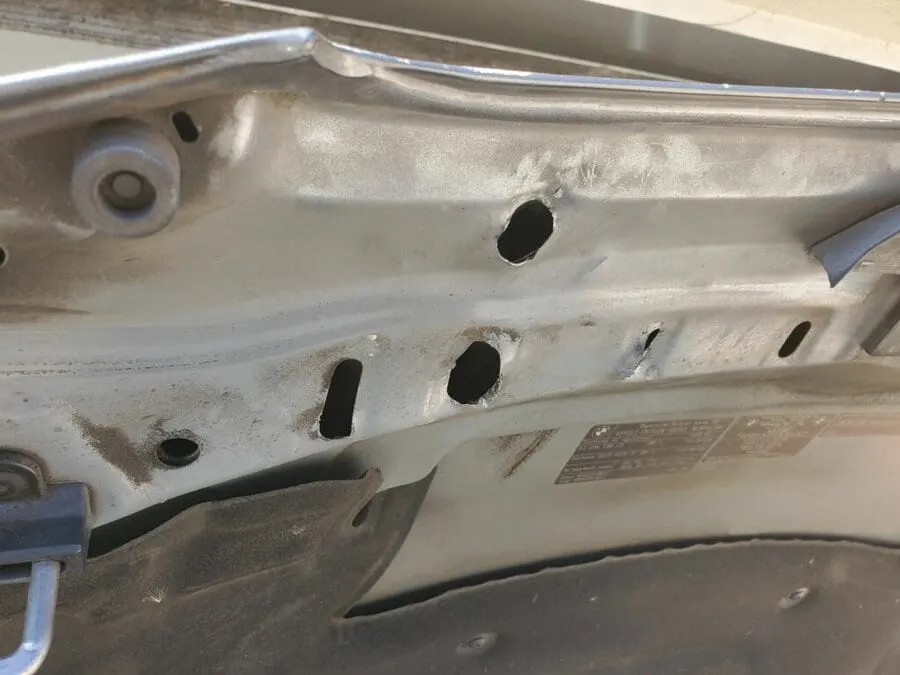
Multiple holes drilled through the panel where none were needed, then left open, unsealed, unprotected. Every one of those openings is now a rust point working inward. The structure is compromised.
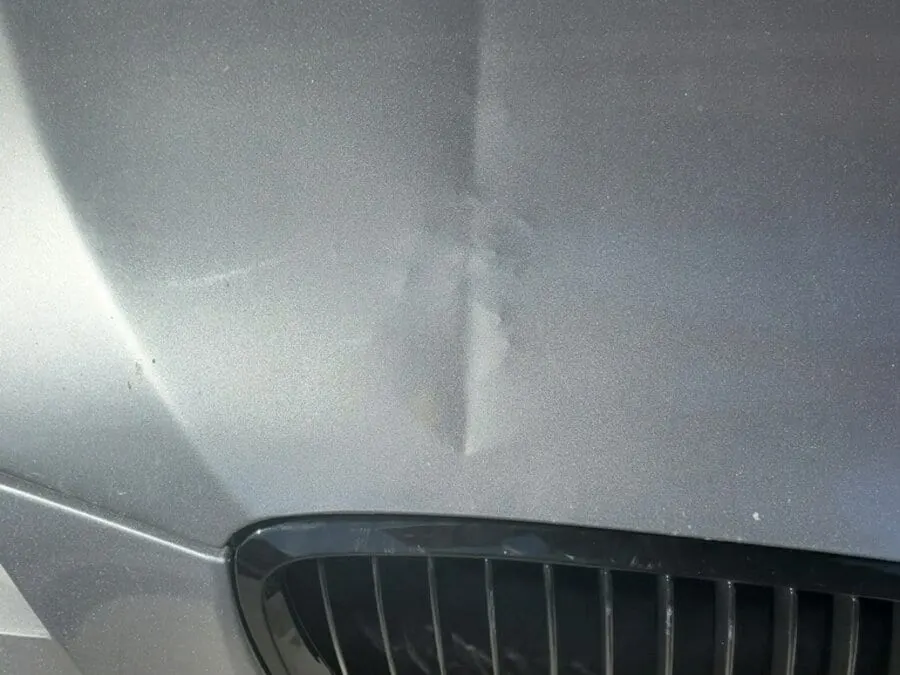
Done by a technician who called himself experienced. A sharp tool pushed with too much force created high spots across the hood and stressed the paint at every contact point. Once the paint is broken from underneath, PDR is no longer an option. The panel needs a full respray.
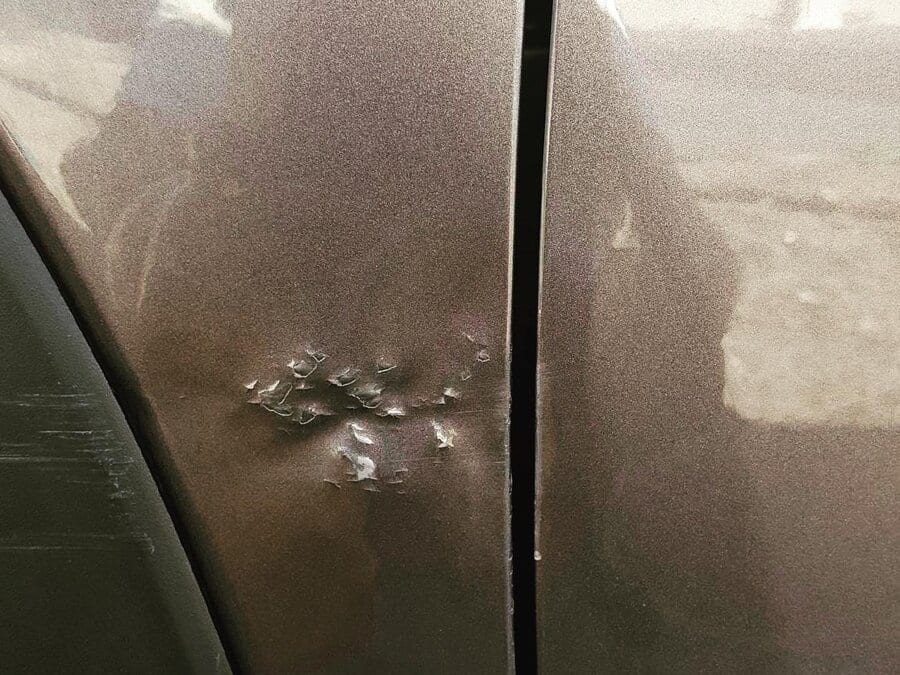
Aggressive pushing with the wrong tools poked the metal up from underneath across the panel. Each raised point broke the paint surface from below. There is no pushing these back down. The factory finish is gone.
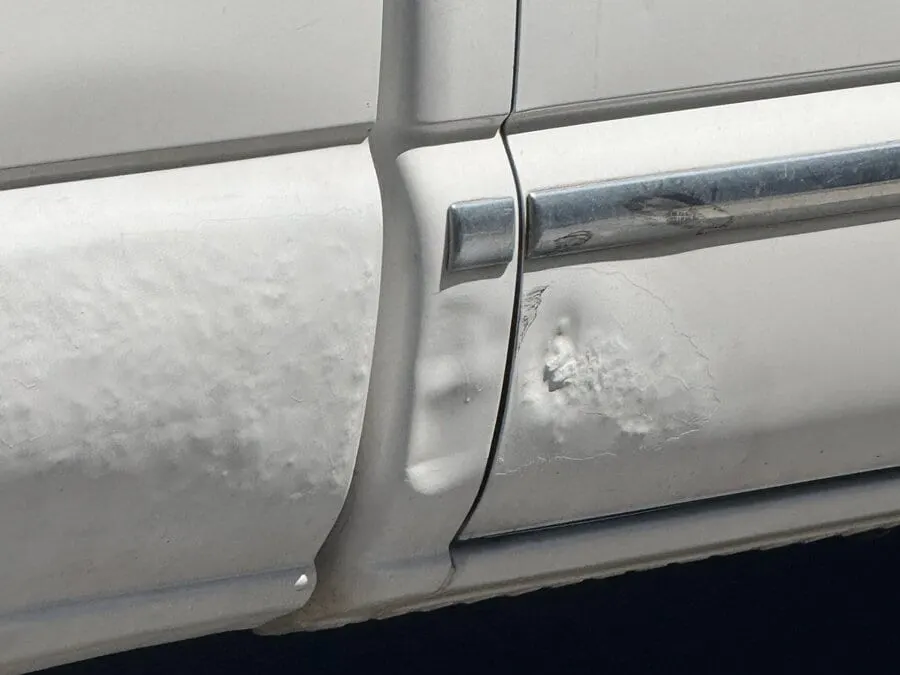
A mobile company in a Walmart parking lot told the owner it would wash away by tomorrow. It didn't. What they applied bonded to the paint and lifted it, leaving the panel in worse shape than the original dent. This car now needs new panels and collision work that could have been avoided entirely.
Every panel above was dent-repairable before the first technician touched it. The damage in these photos was not caused by the original impact, it was caused by the repair. That distinction matters, because it changes what you are actually deciding. The dent is not the risk. The technician is.
Myke Toledo · Dent Time
When you buy a gallon of milk, every gallon at every store is the same product. Choosing the one that costs less makes sense. PDR is not that. Two technicians looking at the same dent will make completely different decisions about access, pressure, and where to stop. One of those decisions preserves your factory finish. The other one does not.
Thirty-five years in this trade is not a marketing number. It is the count of dents, panels, and metal types that live in a technician's hands as muscle memory. You cannot buy that experience at a lower price point. You can only find it or not find it.
The tool does not read the metal. The technician does.
A clean crease repair takes patient work along the body line. Include a straight-on and angled photo in the estimate form so Myke can explain the expected finish, cost, and whether your repair suits mobile or shop service.
Straight reflection lines mean the metal is back to its original plane. No wave, no crown, no trace.
Not in open daylight. Flat sun is the worst light for judging a panel, because it washes out exactly the shallow waves you are looking for. A crease repair that looks perfect in a parking lot at noon can show a wave the moment the light changes.
Two checks anyone can do. Pull into a garage and look down the length of the panel under the overhead lighting, which throws a long even reflection that any remaining wave will break. Or line the car up beside a painted parking stall line and sight down it: the line should run straight and unbroken in the reflection. If it bends where the crease was, the repair is not finished.
That is the same check we do before you pay, under a raking light rather than a guess. Complete satisfaction or no charge applied.
Dent Time repairs creases and body-line dents mobile across San Diego County and at our Escondido shop. Most are finished the same day once scheduled.
Removal and repair are the same job in paintless work, and it runs $225 to $600 for most creases. Nothing is removed and replaced, the original metal is reset.
A crease on a body line runs $350 to $600 because the line has to run dead straight again. Off the line, in the flat of a panel, the same damage runs $225 to $450.
Kits sold for creases are the fastest way to turn a repairable crease into a body shop job. A puller used along a line stretches the metal, and stretched metal does not go back. If you want to try something at home, try it on a panel you do not care about first.
The honest answer is that a door crease is worked from behind the skin in stages, with the door card off for access, reading the line against a board the whole way. The full technique is in our guide on fixing body line dents.
Aluminum is far more challenging than steel and it is not flexible. It does not have the same memory steel does, so it never wants to return to shape on its own. The repair uses heat and sharper tools to manipulate the flow of the aluminum back into place, and that takes more time and far more precision.
None of this is an electric car story. Ford has built the F-150 body in aluminum since 2015, and Toyota, BMW, and Mercedes-Benz use aluminum on hoods, doors, and tailgates across their ranges. If you drive something built in the last decade, there is a good chance at least one panel on it is aluminum.
Almost every question we get about aluminum is some version of "is this repairable?" That is the wrong thing to be nervous about. On an intact-paint panel the answer is nearly always yes.
The real variable is who is doing it. Aluminum punishes inexperience in a way steel never does. Steel forgives a wrong move because it wants to go back. Aluminum records it. The same dent, on the same panel, on the same day, comes out invisible in one set of hands and pock-marked in another.
So the question worth asking a shop is not whether they can fix aluminum. Everyone says yes. Ask how long they have been doing it, and ask to see one they finished.
See what the wrong hands leave behind in real bad repairs, or send two photos and get an honest read on your panel.
A crease runs $225 to $600 for most everyday damage. An open-panel crease away from any body line runs $225 to $450. A crease sitting on a body line runs $350 to $600, because the line has to run dead straight again when it is finished. A long, sharp, or stretched crease runs $500 to $1,500 or more. Text two photos to 858-408-6200 for your actual number in minutes.
A dent is an impact at a point. A crease is an impact along a line, which means the metal is bent over a long narrow area rather than pushed in at one spot. That changes the repair completely. A dent is worked from the middle out. A crease has to be brought back along its whole length in stages, checked constantly against a reflection, because correcting one section pulls on the next.
Yes, and it is the repair that separates technicians fastest. A body line is under tension from both sides, so the metal fights back harder than it does in the open middle of a panel. The line also has to read perfectly straight when the work is finished, and a body line shows a wave from thirty feet away in the right light. It takes longer and costs more than the same damage in the flat, and that is why.
Because size is not what makes it hard. Sharpness is, and so is location. A crease concentrates the bend along a narrow line, which stretches the paint more than a broad dent does, and it usually sits where the panel is least willing to move. Two pieces of damage that measure the same across can be an hour apart in work, which is why an honest quote comes from photos rather than a description over the phone.
Three things, and all three count. How sharp the crease is, how long it runs, and what sits behind the panel. Sharpness decides how hard the metal fights back and how much the paint is stretched. Length decides how much of that fight there is, because every inch has to be worked and re-read. Access decides whether we can reach the back of it at all or whether a door card, a liner, or a light has to come out first. Two creases that measure the same can be hours apart once you know all three.
Yes, when the factory paint is intact. The metal is worked back from behind the panel with no filler and no repaint, which keeps the finish the car was built with and puts nothing on the vehicle history. If the crease cracked the clear coat, and sharp creases sometimes do, the metal can still be shaped but the finish needs its own plan. We tell you which one you have from the photos.
Most creases take 2 to 4 hours. An open-panel crease is usually 2 to 3, a body-line crease 3 to 4, and a long or deep one can take half a day to a full day. Creases take longer than dings because the metal has to come back in stages along the whole length rather than in one area.
Done correctly, no. The metal returns to its original plane, the body line runs straight, and the factory paint is untouched. Done in a hurry, a crease is one of the easiest repairs to leave a wave in. The way to check is not flat daylight, which hides it. Look down the panel under garage lighting, or line the car up against a painted parking stall line, and any remaining wave in the line will show.
Most creases are done mobile at your home or office across San Diego County. A long crease, a sharp one, or a crease on an aluminum panel often routes to our Escondido shop, because reading a line properly needs controlled lighting more than a single ding does. We tell you which one your damage needs when we quote it, not after we arrive.
Considerably. Aluminum has no memory, so it gives nothing back, and a crease already concentrates the work along a line where the metal is least willing to move. Together that is the hardest routine repair in the trade. It is not only a Tesla and Rivian story either. Ford has built the F-150 body in aluminum since 2015, and Toyota, BMW, and Mercedes-Benz use it on hoods and tailgates. Aluminum creases run $400 to $900.
The full technique, and what a crown is when someone leaves one behind.
The everyday version, from $197, usually finished in under 90 minutes.
When the damage is past a crease and the body shop said replace the panel.
The metal with no memory, where a crease is the hardest routine repair there is.
Straight-on and at 45 degrees, with the light running down the length of the crease. A technician replies with your range and an honest read on how sharp it actually is.
Leave your name and number and Myke will call you back during business hours, Monday to Friday, 8:30am to 4pm.
Julie texts you back right away from (858) 408-6200.