Start out crawling. Leave running. The complete program: four weeks hands-on with Myke Toledo, two students maximum, from foundations through hidden crowns, aluminum, and real field repairs at dealerships and retail. Built to train, teach, and test you as much as possible.
Full tutorials, start to finish. The work in these videos is the work you learn to do. Tap WATCH and the page becomes the theater, sound on.
Drag or use the arrows · tap watch for full screen
The 4-week PDR training course is the most complete program Dent Time offers: two students maximum, taught personally by Myke Toledo, moving from real cars in controlled settings to real repairs at dealerships, body shops, and retail clients. It was designed to start you out crawling and end you up running.
The curriculum covers every type of dent that pays in this trade: creases, deep body lines, deep center pit dings, hidden crowns, and trapped pressure dents, with the final 5 to 10 percent of every repair getting the most attention. You build solid work habits and learn the difference between practicing and perfecting, because those are two different things, and only one of them earns a living.
It takes more than a week or two just to understand what PDR is really about. That is why there is no 1-week course here, and why the students who intend to make this their trade choose four weeks. See what actually happens on the learning curve before you commit to anyone.
You advance when the skill is demonstrated, not when the calendar says so.
Board and light reading, body positioning, tool tip location, tap-down technique, vehicle access, basic ding removal, cross-checking. The habits everything else stands on.
Remove and install, power tools, crown theory, metal shrinking, glue pulling, vertical and horizontal creases, and the finishing work that decides whether a repair is invisible.
Body line dents, large dent removal, dent dials, mobile setup, and field trips to real dealerships and retail work. The training leaves the shop because the job does.
Metal shrinking, blending, aluminum, heat, complex dents, leverage technique, and the business and marketing fundamentals that turn a skill into a living.
Anyone can move metal after a few days. The final 5 to 10 percent of the dent is where the trade lives, and it is the difference between a repair that gets paid and one that gets pointed at.
The metal is up, the dent looks smaller, and under shop lights it reads as done. This is where most short programs stop teaching.
The repair disappears. Weeks three and four exist to drill exactly this, on real vehicles, until the standard is a habit.
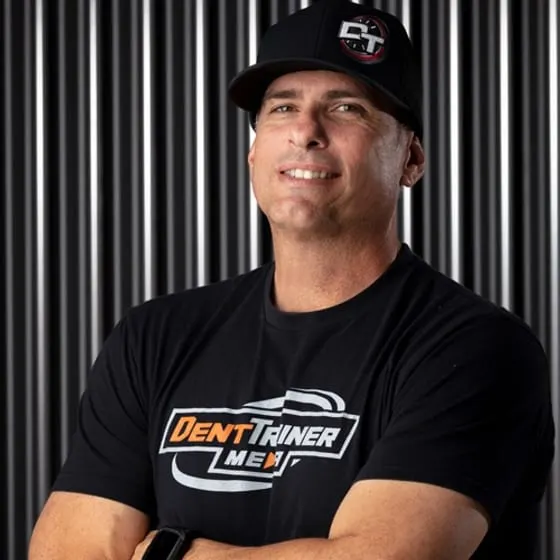
Founder, Dent Time · Founder, Dent Trainer Media · Instructor
A standard is only as real as the person enforcing it at your panel. Myke Toledo has been in paintless dent repair since 1991, founded Dent Time in 2001 with his wife Mary, and has taught the trade to technicians around the world for more than two decades. All four weeks are taught by him personally, and his online library at Dent Trainer keeps working for you long after the course ends.
His online training library By the later weeks, the dents are real and so are the customers.
Most schools keep you at a bench for the whole program. This one is staged to put you in front of real vehicles, then real accounts, then real customers, in that order.
You start on actual vehicles in the Escondido shop, where a mistake is a lesson instead of a claim. Board reading, access, and repair order become routine here.
Field trips into working accounts. You see wholesale pace, lot conditions, and how professionals move through a dealer row without cutting the standard.
The dents are real, the expectations are real, and the repair has to disappear. You finish the course already having done the job you are training for.
Four weeks with two seats will never be the bargain option, and it is not trying to be. This is the program for the person who intends to earn a living with this skill and wants to leave running. Call, get the tuition and the curriculum PDF, and compare it against every school on your research list.
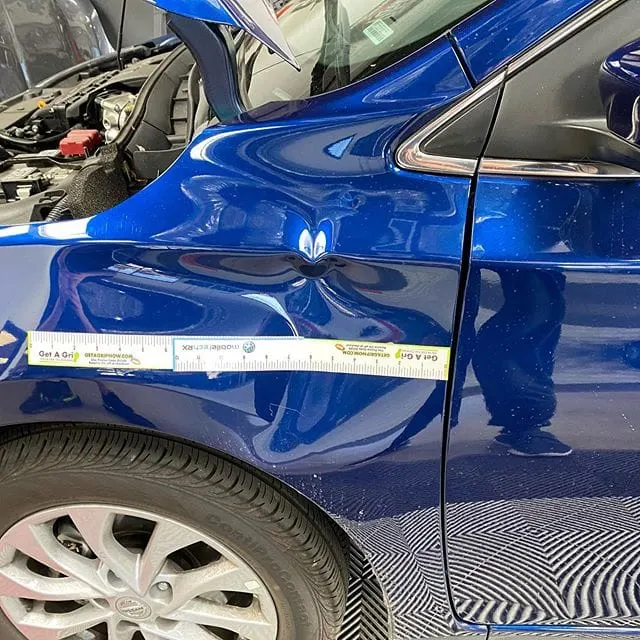
Week three damage. Body lines and stretched metal are exactly what the extra two weeks buy you.
The 2-week course builds the fundamentals correctly for a serious head start or for adding PDR to an existing auto trade. Four weeks is for the person who intends to make this the living. If you are not sure which one you are, the free 15-minute call settles it honestly, and the answer might even be that this trade is not for you. Myke will say so.
The searches that follow "4 week PDR training." Answered by the person who teaches it.
Sharp tools, surgical control. The final 5 to 10 percent of every dent lives here.
Trapped pressure dents and hidden crowns, and it is not close. The metal lies to you until you know how to read it, which is exactly why both live in weeks three and four of this course instead of a weekend seminar. Sharp body-line dents on aluminum are the other honest answer.
Completely. Steel has memory and wants to return to shape, so the technician uses that. Aluminum gives nothing back, punishes overworking, and demands more force with more accuracy at the same time. It gets its own dedicated time in week four because guessing on aluminum is expensive.
Many build their whole year around it. Hail work is high-volume wholesale repair where speed and finishing quality decide what you earn, and the storm map decides where you go. The field weeks of this course are built to show you that pace on real accounts before you chase it alone.
Two ways, and both stay open. You can call your instructor in month three, because our students still do it years later. And Myke founded Dent Trainer, the world’s largest online PDR tutorial library, so the review material for every technique you learned is available anywhere you end up working.
The honest first-year range in paintless dent repair is $20,000 to $60,000. The spread is not decided by skill. It is decided by how many hours per week you put on the panel, plus how much back-end business work you do off the panel. Same PDR ability, three times apart in income. Below is the real curve, stage by stage, in Myke's numbers.
$0 earned
Hands-on training plus full-time practice. Every hour goes into board reading, tap-downs, and finishing on real panels under an instructor. No paid work yet, on purpose.
Learning to close
You start taking on real customers, one to three dents a day, with your own quality bar still louder than any paycheck. Income begins, and how fast it grows tracks with your online presence, not your talent.
Everyday dents feel routine
Four to eight repairs a day is realistic. The habits from training are automatic now. Marketing, website, and repeat referrals start compounding, or they don't, and the ceiling is set right here.
$20,000 to $60,000 total
Myke's real number, not an industry brochure figure. The spread is not decided by skill. It is decided by head trash, discipline, and how much back-end work you actually do.
$50,000 to $100,000+
Everyday and complex dents both feel routine. A real book of business, a referral network, and the option to specialize. Hail season pushes it higher for the technicians who chase storms.
The outlier. Myke has trained students who cleared $100,000 in year one. Every one of them earned it through determination, marketing understanding, and refusing to treat PDR like a hobby. Not through superior PDR skill. That is what the Dedication Multiplier below actually measures.
Two technicians with the same hands, same tools, same training, earn three times apart in year one. What decides the gap is not talent. It is how many hours per week they put on the panel, and how many hours they put behind it on marketing, website, Google Business Profile, and now AI leverage.
The takeaway. A PDR technician earns two ways: on the panel, and off the panel. Ignore either and the number stays small. Do both with discipline and the number grows fast. Money follows passion and discipline. It does not lead them.
Buying too many tools at once at the start of your training, or before it, is detrimental to your learning curve. So is buying tools before you know how to use them. Both hurt you before you have even started, and both are exactly what a lot of schools sell on day one.
Here is the part nobody expects. Three to five tools will make you a more efficient technician than a student who owns a hundred. That is not an exaggeration. That is what happens, every time, and the reason is focus rather than equipment.
A tool package bundled into tuition before you have pushed a single dent is not an instruction philosophy. It is margin. You have not earned the right to choose those tools yet, because you do not know what they do.
More than 75 percent of the time, people who buy before training buy the wrong ones. Not bad tools. Wrong ones, for the way they will end up pushing metal, which nobody knows yet on day one.
People believe the more they have, the better their chances. It is the opposite. The less you have, the better your concentration. Fewer distractions. Fewer chances to put the tool down instead of pushing through.
With a hundred tools you never give yourself enough time to understand the usage and capability of any single one. With three to five, you actually do.
“It's like golf. You don't go and get the generic clubs. You go to a real golf place and get fitted, because it's based on you. As a beginner, the more tools you have, the more you hurt your focus.”
Myke Toledo, on the tools since 1991How it works here instead. You learn what the tools are, which panels they are used on, and why that one with purpose. There are five or six tools that do the same job for each type of repair, and in four weeks you get to try them. Then you buy your own, once your choices are educated rather than guessed. Read the tools of the trade guide before you spend anything.
Ask any school this before you pay them. Roughly half the vehicles on the road now carry aluminum panels, and aluminum is the opposite of working sheet metal. It has no memory. Steel wants to return to shape and works with you. Aluminum gives nothing back and works against you the whole way.
You push three to five times harder, sometimes more, with sharper tools and far more accuracy. Now put that in the hands of a student who cannot yet use a sharper tool on steel. They push too hard, or in the wrong place, and the paint pays for it.
A graduate who never touched aluminum finds out on a customer's car. It makes you feel like you are pushing on plastic. Wrong tool, no heat, board not moving properly, nothing reading the way it did in class. That is not a skill gap you talk your way out of in front of the owner.
It is not only a Tesla and Rivian story either. Ford has built the F-150 body in aluminum since 2015, and Toyota, BMW, and Mercedes-Benz use it on hoods and tailgates across their ranges. This is daily work now, not specialist work.
“Once you understand it, it's like changing gears. You'll be able to be very aggressive but still precise.”
Myke ToledoWhat that means for this course. Aluminum is not an add-on module here. Reading the board, choosing the tool, controlling the tip, using heat, and tapping down correctly are the same fundamentals that decide whether you can push aluminum at all. You get the foundation first and aluminum on top of it, so the resistance is something you were prepared for instead of something that ambushes you.
Sort out what is going on in your life before you get here. Do not bring the drama in your head into the shop with you, because it is detrimental to your learning curve and you need every bit of concentration you can get.
Most schools will take your money regardless of where your head is at. We have had people realize partway through that they had things to handle at home first. Saying this up front costs us enrollments and saves you a lot of time, money, and frustration. That trade is worth it.
The vehicles that pay the best are the ones nobody wants to hand to a beginner.
Tuition, the full curriculum PDF, and an honest read on where you are starting from. No pitch, no pressure, and no promises a real trade cannot keep.