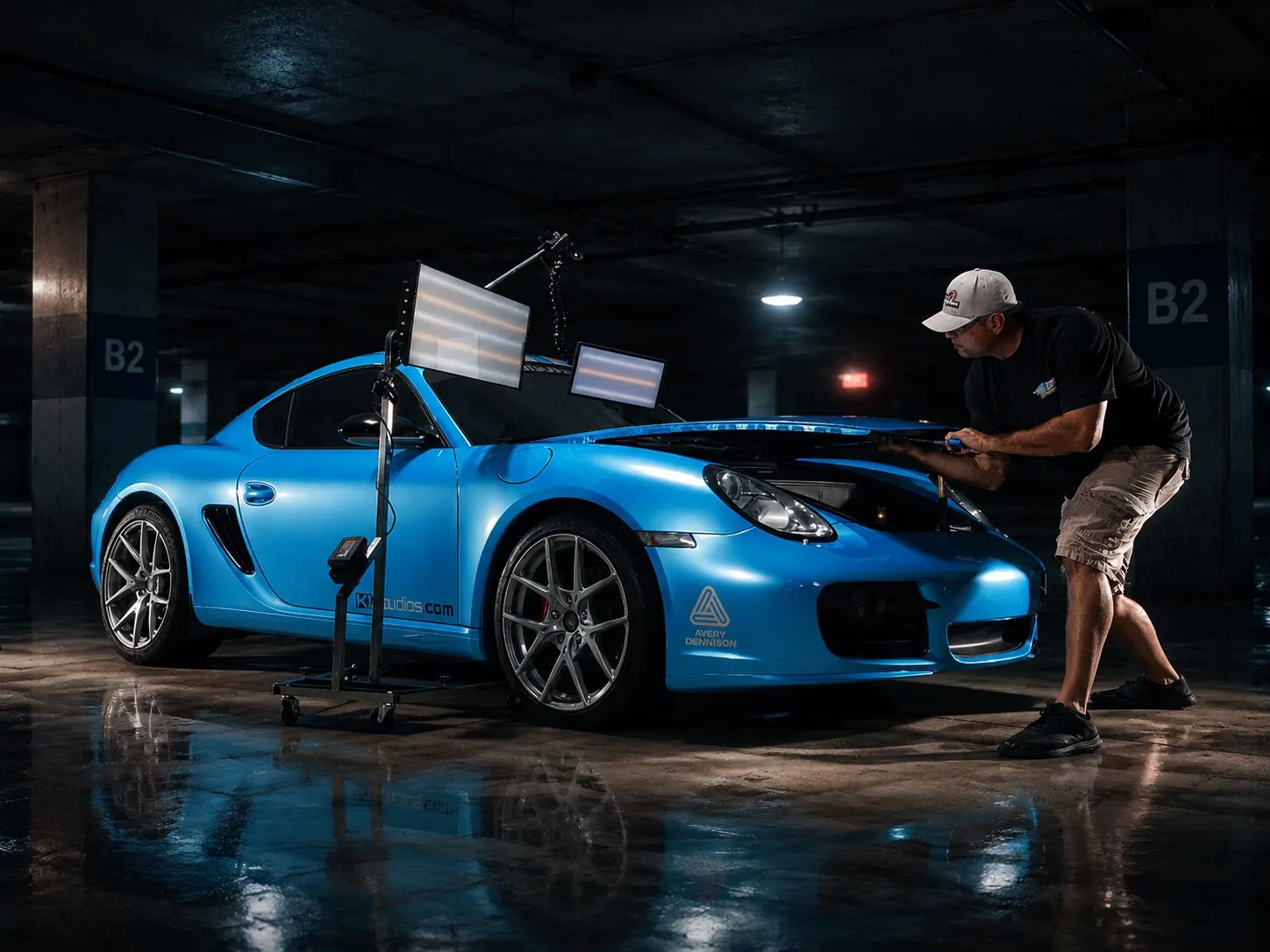
The rods and tips that reach a dent from behind the panel.
People love to ask me what tools I use, as if the right rod in the right brand is the secret to paintless dent repair. I have been on these tools since 1991, and I train technicians around the world, so let me tell you the part nobody wants to hear. The tools matter, but the eyes matter more. A rod is leverage. The skill is knowing exactly where to push, exactly how hard, and exactly when to stop.
This is a walk through the real tools of the trade and what each one does in plain language. By the end you will understand why two technicians can hold the identical tool over the identical dent and get two completely different results. The tool did not change. The reading of the panel did. Several of the boards and tools named here are ones we sell, and those live in the PDR tools store.
What are PDR rods and whales tails used for?
Steel rods and whales tails push a dent out from behind the panel, using leverage to move metal back to its original shape.
Rods are the backbone of paintless dent repair. They come in dozens of lengths, diameters, and tip shapes so a technician can reach behind a panel through a window channel, a tail light opening, or a seam, and place a tip on the exact low point of the dent. The whales tail is a flat, wide blade style tool that spreads force across a body line or a long crease where a thin rod tip would leave a high spot.
Here is what a new technician misses. The rod does not do the work, the placement does. I can hand you the finest rod made and you will chase a dent all over a door if you cannot read where the true low point sits. On steel the metal has memory and wants to return to shape, so a trained push works with that tendency. Reaching the dent is access. Moving it correctly is craft. That gap is what the months of practice in the PDR learning curve are really closing.
What do tap down tools and knockdowns do?
Tap down tools and knockdowns bring high spots back down, smoothing the metal a technician pushed slightly too far.
Pushing a dent out is only half the motion. Almost every repair creates small high spots around or inside the original damage, and those high spots have to come back down to a level finish. A knockdown is a hardened tip, often with a blending head, that the technician taps with a light hammer to ease that raised metal flat without marking the paint.
Reading where to tap is the whole game. A high spot the size of a grain of rice can ruin a reflection, and you cannot fix what you cannot see. This is why a tap down is never random hammering. It is a series of small, deliberate touches, each one checked against the panel before the next. Over tapping creates new lows, and now you are fighting yourself. The line between a clean finish and visible damage is the difference between good and bad paintless dent repair.
How do glue pull systems work in PDR?
Glue pull systems bond a tab to the outside of the panel so a dent can be pulled out when there is no access behind the metal.
Sometimes there is no way to reach the back of a dent. Bonded panels, braced areas, foam filled sections, and tight spots all block a rod. That is where glue pulling earns its place. The technician warms a special adhesive, attaches a plastic tab sized to the dent, and uses a slide hammer or a bridge tool to pull the metal outward from the front, then releases the tab cleanly.
Glue pulling is common on aluminum and on modern vehicles where panels are sealed up tight. Aluminum has no memory, so it gives nothing back and takes far more controlled force and accuracy to set into shape. The mistake people make is treating glue pulling as the easy button. Pull too aggressively and you create a high spot that still needs knockdowns and reading. It is another way to move metal, not a shortcut around the skill.
Why is the reflection board the most important tool?
The reflection board is the striped light source a technician reads the panel's reflection in, and it is the most important tool because PDR is reading distortion in a reflection.
If I could only keep one tool, it would be the reflection board, also called a line board. It throws bands of light and shadow onto the panel, and the technician works by watching how those lines bend and wobble across the dent. A dent is not a hole you fill, it is a distortion in a reflection, and the board is how you see that distortion clearly enough to chase it out one push at a time.
This is the part that separates paintless dent repair from every other kind of body work. The rod and the glue tab move metal, but the board tells you whether you moved it correctly, and by exactly how much more it needs. A trained eye reading a good board will catch a flaw a customer would never notice until the sun hit it in a parking lot. Proper lighting is not a comfort, it is the instrument. No board, no read. No read, no repair.
Reading the panel in the line board, the most important tool in PDR.
Does the brand of PDR tool make a technician better?
No, the brand of PDR tool does not make a technician better, because the reading of the panel and the control of the push are the skill, not the steel.
New people get caught buying kits, convinced the next set of rods will unlock the results they see online. I understand the urge, and quality tools do help once you can use them. But a beginner with the best kit made will still struggle, because the kit cannot read the reflection or judge the push for them. The tool is leverage waiting for a trained hand.
This is also why repair pricing has nothing to do with the tool in hand and everything to do with access, panel material, and how the metal responds. If you want to understand that side, why PDR cost varies walks through it. The honest answer to anyone asking which brand to buy is that the years of reading come first, the tools come second, and there is no kit that reverses that order.
Can you learn all these PDR tools quickly?
You can learn what each tool is in an afternoon, but learning to read a panel and control every push is a craft that takes years to master, not days.
Naming the tools is the part you can do quickly. Anyone can learn that a rod pushes, a knockdown taps, a glue tab pulls, and a board reveals. The hard part, the part that takes years, is building the eye that reads a reflection and the hands that move metal exactly the right amount, on the first try, without chasing.
I have trained technicians worldwide, and the ones who last are the ones who respect that timeline instead of fighting it. If you have seen a fourteen day promise and wondered, I wrote honestly about whether you can really learn PDR in 14 days. Tools of the trade are a starting line, not a finish line. The trade itself is in the reading.
Questions, Answered.
What are the main tools used in paintless dent repair?
The core tools are steel rods and whales tails that push a dent out from behind the panel, tap down tools and knockdowns that bring high spots back down, glue pull systems with tabs that pull a dent from the front when there is no rear access, and the reflection board that lets the technician read the panel. Proper lighting and blending tips round out the set.
What is a reflection board in PDR and why does it matter?
A reflection board, or line board, is a striped light source the technician reads the panel's reflection in. It matters most of all because paintless dent repair is the work of reading distortion in a reflection. Without seeing how the lines bend over a dent, there is no way to know where to push or whether the metal moved correctly.
When do PDR technicians use glue pulling instead of rods?
A technician uses glue pulling when there is no access behind the panel, such as bonded, braced, or foam filled sections, and tight spots a rod cannot reach. A tab is bonded to the outside of the panel and the dent is pulled outward from the front. It is common on aluminum and on modern sealed up panels.
Does buying expensive PDR tools make me a better technician?
No. Quality tools help once you can use them, but the skill of paintless dent repair is reading the reflection and controlling each push, not the brand of steel in your hand. A beginner with the finest kit will still struggle, because the tool is only leverage waiting for a trained eye and hand.
Why does aluminum change how PDR tools are used?
Aluminum has no memory, so it gives nothing back the way steel does and takes far more controlled force and accuracy to set into shape. Because many aluminum panels are also sealed up tight, technicians lean more on glue pulling from the front, and every push and pull has to be read carefully against the board to avoid high spots.
How long does it take to master the tools of PDR?
Learning what each tool does takes an afternoon. Learning to read a panel in a reflection board and move metal the exact right amount on the first try is a craft that takes years to master, not days. The tools are a starting line, and the reading of the reflection is the trade itself.